
Home Chemical agent monitoring
Chemical agent monitoring
With the aim of making the Security service increasingly integrated for our clients, 3i group is launching the Chemical Agents Monitoring project. This initiative utilizes a specialized team and appropriate equipment, ensuring maximum reliability and validity of results, which benefits both time and cost. Indeed, regulations require employers to identify, assess, and monitor chemical, physical, and biological environmental factors arising from production activities.
Why choose us
Thanks to the continuous comparison with different professionals, the service of Chemical Agent Monitoring allows a correct procedure and guarantees reliability and validity of the results.
Here is our winning formula:
– a specialized team at your complete disposal
- application of all sampling phases
– Guarantee of deadlines, in line with the client's
– results management with adequate instrumentation

Objectives
The Chemical Agent Monitoring allows you to:
1. locate the presence of risk situations evident for workers, in order to provide information on measures prevention and protection to be adopted to maintain acceptable risk levels;
2. Focus health monitoring on the most appropriate clinical examinations for the worker health monitoring, so as to ensure early diagnosis of any occupational diseases.
All of this is made possible by the following activities carried out by our specialized team:
- identification of pollutants
knowledge of Amount of substance to which a subject is exposed
knowledge of exposure time, by resorting to limit values
– assessment of Possible routes of entry into the body (ingestion, inhalation, skin contact) by the substance itself.
A process of continuous control and improvement
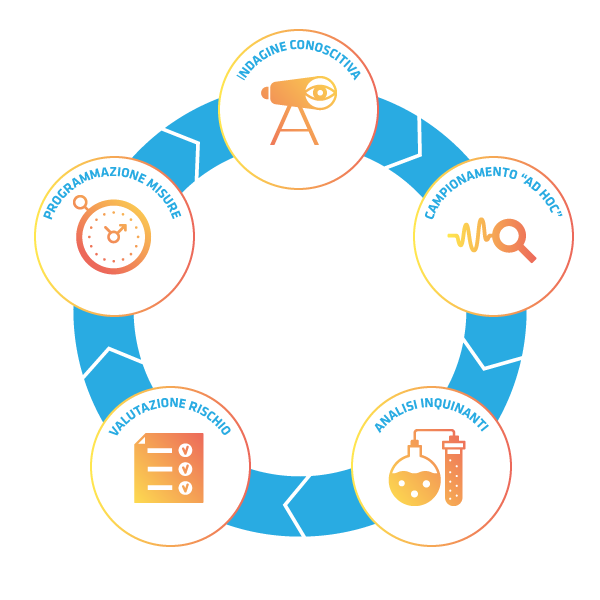
Fact-finding investigation
Chemical risk assessment can only be effectively carried out with a interactive approach that puts together the hygienic, toxicological, health, engineering knowledge, and workers' subjective experiences; Therefore, it cannot be considered a “one-off” fulfillment (whether prescriptive or not), but rather, as far as possible, a process of continuous control and improvement.
2. "Ad Hoc" Sampling"
Sampling is a crucial step in determining’Worker exposure to hazardous agents in the workplace.
Often, a preliminary study of work cycles is not sufficient, because of the environmental variability.
For these reasons, we must proceed with:
- preliminary results review;
– collaboration of the staff, a source of valuable information;
– Close observation of work activities by expert occupational hygiene technicians.
This way sampling can respond to “Representativeness” requirements”, faithfully reproducing the worker's actual exposure.
The mode and duration of the sampling must therefore be adapted to the specific job activity studied.
Types of Sampling
Workplace monitoring is carried out with two main types of sampling:
– personal sampling
– sampling on fixed workstations
Personal sampling are carried out by distributing Vacuum pumps to every representative worker of each job who, through membranes or adsorbent vials, capture substances harmful to human health.
Sampling at fixed locations they are used to determine the level of potential contamination at a specific point in the workplace to identify the main sources of pollution.
air sample analysis will determine the average concentration of substances present in the ambient air during the period when the sampling was carried out.
“Ad hoc” sampling tools”
The equipment needed to collect an air sample is varied.
I personal samplers They are small-sized devices that can be worn by various operators to track their movements and They are not bound to fixed points for refueling..
They must meet specific technical requirements:
constant pump range for the entire duration of the draw;
- Wide flow range, with simple, easy, and precise adjustment capability;
– adequate prevalence of the sampling pumps;
– reliable system for quantization or counting of sampled air volume;
– presence of battery charge status indicator devices or sampling difficulties due to overload of the collection substrate;
– battery life also of extended duration;
– minimum size and weight;
- Explosion-proof construction properties for use in hazardous areas.
3. LABORATORY ACCREDITED FOR POLLUTANT ANALYSIS
The analysis of the sampled pollutants uses the most modern analytical techniques, today widely available, however. The sample collected is analyzed at accredited laboratory, extracted from the substrate with specific techniques appropriate for each substance, through official methods.
4. DATA PROCESSING AND CHEMICAL AND/OR CARCINOGENIC RISK ASSESSMENT
3i Group's thirty years of expertise in security allows for proceeding with the final phase of the investigation: a Specific description of working conditions, with the’Data processing and the next one chemical and/or carcinogenic risk assessment.
5. MEASUREMENT PROGRAMMING & PERIODIC MEASUREMENTS
The measure programming it is a direct consequence of the first evaluation, aimed at:
– to arrive at a Proof of compliance with the exposure compared to the limit value, in the event that the first assessment resulted in a conclusion of uncertainty;
– ensure that the’worker exposure It holds up over time below the threshold value.
The periodic monitoring strategy is complementary to other risk management measures, which always take priority and must highlight the most significant changes in operating conditions in relation to occupational exposure.
The periodic measurements they pick up subtler and/or less immediately obvious variations in exposure.
The frequency of repeating measurements is defined by evaluator, not only by considering the “proximity” of the exposure value to the limit value, but also other factors such as:
A toxicity level of the substance;
A degree of variability of processes (manual/automated);
the’effectiveness control systems;
the’Work organization (e.g., turnover).
The periodicity of non- it will therefore be an application automatic, also to achieve the correct cost-benefit ratio of the application, within a framework of full collaboration with the Customer.
 Italian
 English